The drawdown is the minimum account level that must be maintained. If the account equity reaches or falls below this level, the account will be disqualified.
To understand how drawdown works, it is important to distinguish the following terms:
Balance: the result of all closed trades.
Equity: the current balance plus the unrealized profits or losses from open trades.
Drawdown level: the minimum level the account equity must remain above.
Available margin: the distance between the current equity and the drawdown level.
The available margin is calculated as follows:
Current Equity − Drawdown Level = Available Margin
Trailing Drawdown
Trailing Drawdown updates in real time and follows the highest equity reached by the account, including unrealized profits from open trades.
When the equity reaches a new high, the drawdown level also moves upward. If the equity later decreases, the drawdown level remains at the highest level previously reached.
Example
A $50,000 account has a $2,000 Trailing Drawdown.
The initial drawdown level is:
$50,000 − $2,000 = $48,000
During an open trade, the equity reaches $51,000. The drawdown level immediately moves to:
$51,000 − $2,000 = $49,000
The trade then moves back and closes with a profit of $500. The account balance is $50,500, but the drawdown level remains at $49,000 because it already followed the highest equity reached.
The available margin is:
$50,500 − $49,000 = $1,500
Although the trade closed with a profit, $500 was given back from the highest equity reached. As a result, the available margin decreased.
EOD Drawdown — End of Day
EOD Drawdown updates at the end of each trading day. It uses the highest closed balance recorded at the end of a trading day.
Unlike Trailing Drawdown, unrealized profits from open trades do not move the drawdown level during the session.
However, the account can reach the drawdown limit at any time during the trading day. Throughout the session, the equity must remain above the drawdown level established at the end of the previous trading day.
The EOD drawdown add-on must be selected when purchasing the Evaluation. Once selected, it remains active during both the Evaluation and the Profit Account phases.
Example
A $50,000 account has a $2,000 EOD Drawdown.
The initial drawdown level is:
$50,000 − $2,000 = $48,000
The account finishes the trading day with a closed balance of $51,000. At the end of the day, the drawdown level updates to:
$51,000 − $2,000 = $49,000
At the beginning of the next trading session, the account has:
Balance: $51,000
Drawdown level: $49,000
Available margin: $2,000
If the equity reaches $49,000 during the next session, the account will be disqualified.
Open Profits with EOD Drawdown
An account begins the day with a balance of $50,000. During an open trade, the equity reaches $53,000, but the account finishes the trading day with a closed balance of $51,000.
The temporary equity of $53,000 does not move the EOD Drawdown. The drawdown level updates using the closed balance of $51,000:
$51,000 − $2,000 = $49,000
This is the main difference between the two drawdown types:
Trailing Drawdown follows the highest equity reached in real time, including unrealized profits.
EOD Drawdown uses the highest closed balance recorded at the end of a trading day.
Static Drawdown
A Static Drawdown is a fixed drawdown level that no longer moves upward with the account balance or equity.
The drawdown becomes static only during the Profit Account phase. During the Evaluation phase, it continues to operate as Trailing Drawdown or EOD Drawdown and does not become static.
There are two ways for a drawdown to become static:
The Profit Account generates profits equal to the total drawdown amount plus $100.
A withdrawal is requested from a FREES Max account before that profit level is reached.
Reaching the Drawdown Amount Plus $100
This condition applies to all Profit Accounts.
When the account generates profits equal to the total drawdown amount plus $100, the drawdown stops moving and becomes fixed at the corresponding level.
| Account size | Total drawdown | Profit required | Required balance | Static drawdown level |
|---|---|---|---|---|
| $25,000 | $1,000 | $1,100 | $26,100 | $25,100 |
| $50,000 | $2,000 | $2,100 | $52,100 | $50,100 |
| $100,000 | $3,000 | $3,100 | $103,100 | $100,100 |
For example, a $50,000 Profit Account has a $2,000 drawdown.
The account must generate:
$2,000 drawdown + $100 = $2,100 in profits
When the balance reaches $52,100, the drawdown becomes static and is fixed at $50,100.
From that point onward, the drawdown remains at $50,100, even if the balance increases to $55,000 or $60,000.
If the balance reaches $55,000, the available margin is:
$55,000 − $50,100 = $4,900
Once the drawdown becomes static, additional profits increase the available margin.
Requesting a Withdrawal from FREES Max
FREES Max accounts do not require a safety buffer before requesting a withdrawal.
If a withdrawal is requested before the account generates profits equal to the total drawdown amount plus $100, the drawdown still becomes static at the account’s initial balance plus $100.
The static drawdown level is:
$25,000 account: $25,100
$50,000 account: $50,100
$100,000 account: $100,100
For example, if a withdrawal is requested from a $50,000 FREES Max Profit Account before the balance reaches $52,100, the drawdown becomes static at $50,100.
From that moment onward, the drawdown remains fixed at that level and no longer moves upward with the account balance or equity.
Quick Comparison
| Drawdown type | When does it update? | What does it follow? | Does it include unrealized profits? | Does it continue moving upward? |
|---|---|---|---|---|
| Trailing Drawdown | In real time | Highest equity reached | Yes | Yes, until it becomes static in the Profit Account |
| EOD Drawdown | At the end of the trading day | Highest end-of-day closed balance | No | Yes, until it becomes static in the Profit Account |
| Static Drawdown | It no longer updates | Fixed drawdown level | No | No |
How to Read Drawdown on the Dashboard
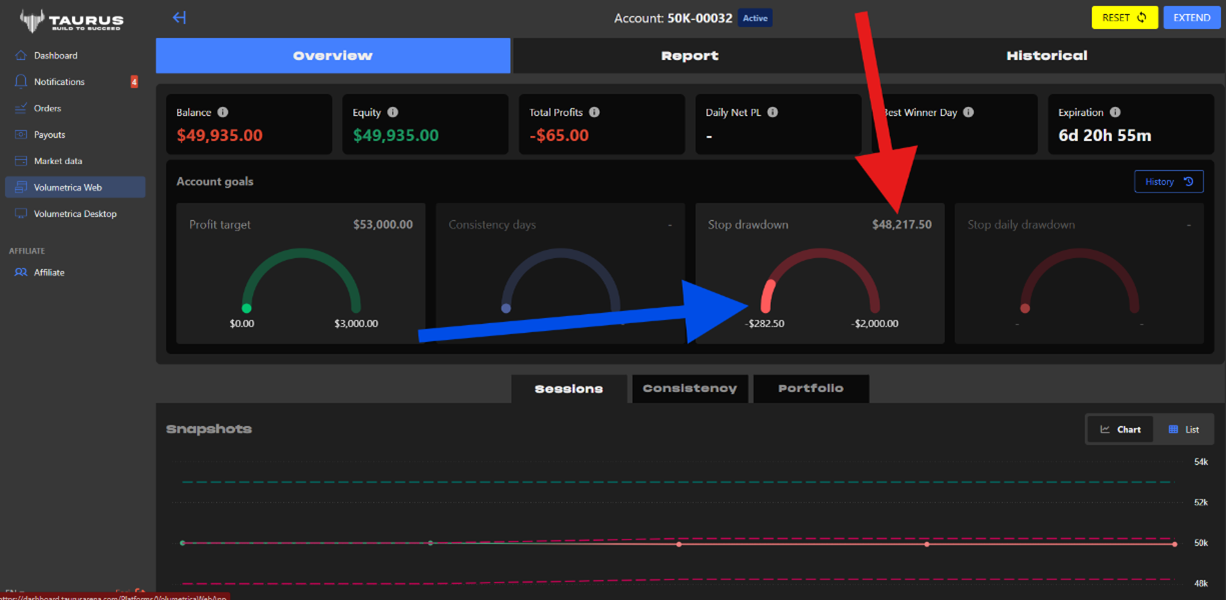
Trailing Drawdown, EOD Drawdown, and Static Drawdown are read in the same way on the dashboard.
The dashboard shows the active drawdown level and the remaining distance before the account reaches the disqualification limit.
The red arrow shows the current drawdown level. The account equity must remain above this value. If the equity reaches or falls below the level shown by the red arrow, the account will be disqualified.
The blue arrow shows how much of the drawdown has already been used and how much available margin remains.
Was this article helpful?
That’s Great!
Thank you for your feedback
Sorry! We couldn't be helpful
Thank you for your feedback
Feedback sent
We appreciate your effort and will try to fix the article